When your to-do list keeps growing, it can be hard to know where to start. You may feel busy all day but still end the day without making real progress. Task prioritisation helps you focus on the work that truly matters.
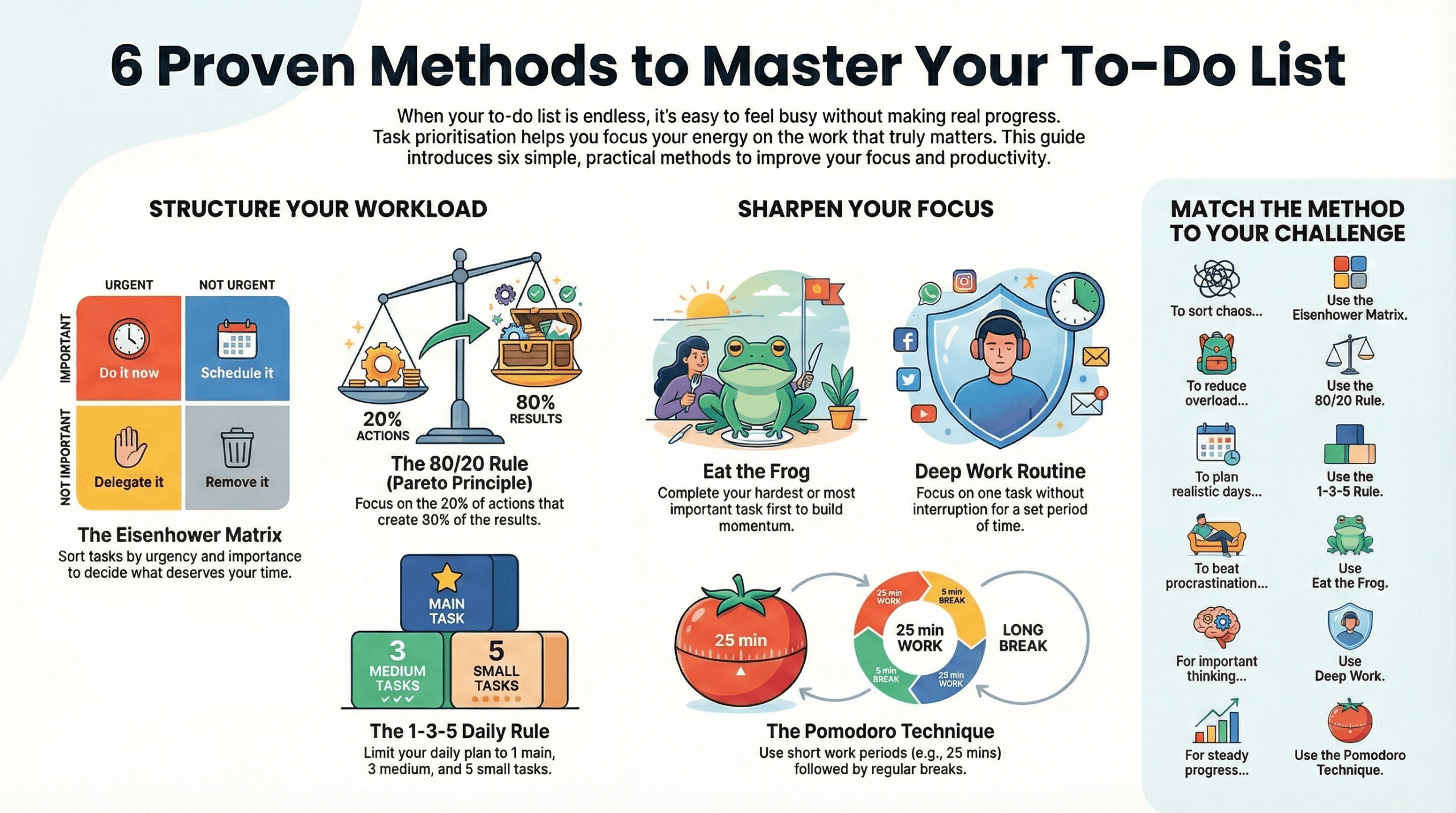
This guide explains six proven prioritisation and productivity methods. Each one is simple, practical, and easy to apply.
1. The Eisenhower Matrix
What it is
The Eisenhower Matrix helps you sort tasks by urgency and importance, so you can decide what deserves your time.
When to use it
Use it daily for short-term planning or weekly or monthly for larger workloads.
Why it works
You often spend time on tasks that feel urgent but have little impact. This method helps you step back and focus on work that truly moves things forward.
How to use it
List all your tasks, then place each one into one of four categories.
| Task type | What to do |
|---|---|
| Important and urgent | Do it now |
| Important but not urgent | Schedule it |
| Not important but urgent | Delegate it |
| Not important and not urgent | Remove it |
2. The 80/20 Rule, also known as the Pareto Principle
What it is
The 80/20 rule helps you focus on the small number of actions that create the biggest results.
When to use it
Use this method when your workload is too large and you need to cut back fast.
Why it works
In many areas of life, a small number of inputs create most of the value. By finding those inputs, you stop wasting energy on low-impact tasks.
How to use it
Look for the most valuable 20 per cent in different areas of your work.
Examples include
- The 20 per cent of tasks that deliver the most results
- The 20 per cent of clients that generate most income
- The 20 per cent of feedback that drives improvement
- The 20 per cent of exercise that builds most strength
3. The 1 3 5 Daily Rule
What it is
This method limits how much you plan to do in one day.
When to use it
Use it if you often end the day with an unfinished to-do list.
Why it works
Planning too much leads to frustration and delay. Choosing fewer tasks helps you finish more.
How to use it
Each day, select only the following:
- 1 main task that matters most
- 3 medium-sized tasks
- 5 small and quick tasks
Do not add anything else. Many people find it works best to plan the night before, when your mind is calmer.
4. The Eat the Frog Method
What it is
This approach asks you to complete your hardest or most important task first.
When to use it
Use it when you keep avoiding a task that feels difficult or uncomfortable.
Why it works
Tasks often feel worse in your head than they are in reality. Finishing them early builds confidence and momentum.
How to use it
Follow three simple steps.
- Identify the task you keep putting off.
- Start it first thing in the day
- Acknowledge the win and move on
5. Building a Deep Work Routine
What it is
Deep work means focusing on one task without interruption for a set period of time.
When to use it
Use this method if messages, emails, or noise keep breaking your concentration.
Why it works
Multitasking reduces quality and speed. Focused work allows deeper thinking and better results.
How to use it
Create a routine that protects your attention.
- Block time in your calendar and treat it as fixed
- Turn off your phone and notifications.
- Close email and messaging tools
- Start with one hour and increase to three when possible
6. The Pomodoro Technique
What it is
The Pomodoro Technique uses short work periods followed by regular breaks.
When to use it
Use it when you need sustained focus but feel tired or unfocused.
Why it works
Your brain works best in short bursts. Regular breaks help prevent fatigue and loss of focus.
How to use it
The basic structure is simple.
- Work for 25 minutes
- Take a 5-minute break.
- Repeat the cycle
You can adjust the timing to suit your energy levels. During each work period, focus on only one task. During breaks, step away from your screen.
Choosing the right method for you
You do not need to use all six methods at once. Start with one that fits your current challenge.
- Use the Eisenhower Matrix to sort chaos.
- Use the 80/20 rule to reduce overload.
- Use the 1 3 5 rule to plan realistic days.
- Use Eat the Frog to beat procrastination.
- Use deep work for important thinking.
- Use Pomodoro for steady progress
Frequently asked questions about task prioritisation
What is task prioritisation?
Task prioritisation means deciding which tasks you should do first.
It helps you focus on the work that matters most and avoid spending time on low-priority tasks.
Why is it important to prioritise tasks?
Prioritising tasks helps you manage your time and reduce pressure.
It makes it easier to complete important work and avoid feeling overwhelmed.
What is the Eisenhower Matrix?
The Eisenhower Matrix is a way to sort tasks by importance and urgency.
You place each task into one of four groups to decide what action to take.
These groups are
- do now
- schedule for later
- delegate to someone else
- remove
When should you use the 80/20 rule?
Use the 80/20 rule when you have too much work to manage at once.
It helps you identify the small number of tasks that deliver the most results.
What is the 1 3 5 rule?
The 1 3 5 rule limits how many tasks you plan each day.
You choose.
- 1 main task
- 3 medium tasks
- 5 small tasks
This helps you set a realistic daily plan.
What does “eat the frog” mean?
Eating the frog means doing your most difficult or important task first.
This can make the rest of the day feel easier and help reduce delay.
What is deep work?
Deep work is time set aside for focused work without interruptions.
It helps you concentrate on one task and produce better quality work.
How long should deep work last?
Start with one hour of deep work.
If possible, increase this to two or three hours over time.
The key is to protect this time from interruptions.
What is the Pomodoro Technique?
The Pomodoro Technique is a way of working in short time blocks.
You work for a set period, usually 25 minutes, then take a short break.
Can you use more than one prioritisation method?
Yes.
You can use different methods together, depending on your needs.
For example, you might plan your tasks using one method and manage focus using another.